
Win Loss Analysis Program: Belief Isn't Strategy, Buyer Truth Is.
AI-Powered CI + Win-Loss Are the PMM Stack You Need.
You didn’t lose the deal because of price. Or a missing feature. Or bad timing.
You lost it because you didn’t know what actually mattered.
And when product, sales, or marketing builds strategy based on what we think, not what we know, we lose more than deals. We lose direction.
Revenue leaders depend on accurate sales data and a clear understanding of their win loss ratio to drive strategic decisions, yet many don’t know what their true win rate is—leading to missed opportunities for improvement. According to Crayon‘s 2025 State of Competitive Intelligence report,68% of B2B deals are competitive (Crayon, 2025). But most teams still make decisions in a vacuum, guided by instinct, internal opinions, or last week’s call recap.
Product marketing can/should fix that. Not by guessing better, but by listening better.
The Modern Feedback Loop
High-performing teams don’t rely on belief. They build a loop.
One that captures what buyers are saying. Validates it across the market. And feeds it straight into the decisions that move pipeline.
This feedback loop relies on both structured data and qualitative data from buyer interactions to glean insights that drive better decisions.
That loop has two engines:
Win-Loss Analysis → buyer truth
Competitive Intelligence → market truth
And when powered by AI, that feedback gets faster, sharper, and easier to act on.
Win-Loss Analysis: What the Buyer Actually Said
A good win-loss program answers the question we keep pretending we already know: Why did we win, or lose, that deal? A comprehensive win-loss analysis program systematically gathers insights from win loss interviews, one on one conversations, surveys, and CRM data to identify the reasons behind deal outcomes for specific sales deals and sales opportunities throughout the deal cycle.
Not internally. Not “what the AE thinks.” Not a dropdown in Salesforce. But straight from the buyer.
With tools like Clozd,Klue , or UserEvidence, you uncover:
What truly influenced the decision
Where your product and pitch resonated, or didn’t
What competitors promised (and buyers believed)
What tipped the scale in your favor, or theirs
Customer feedback from both won deals and lost prospects to understand key factors influencing closed deals
This isn’t anecdotal. It’s directional. Conducting interviews with decision-makers at both won and lost accounts—ideally through a neutral third party—provides the richest insights. Aligning the analysis of win-loss data with clear learning objectives and identifying key themes in each win loss interview is crucial for deriving actionable insights.
According to the 2025 State of Win-Loss Analysis Report63% of companies improve win rates with win-loss And for teams running programs longer than two years, that jumps to 84% (Clozd, 2025).
As a PMM, you can’t afford not to know this. Sales teams often have misconceptions about why they win or lose deals, so direct buyer feedback is essential for accurate understanding.
Setting Up a Win-Loss Program
Launching a win-loss program is the first step toward transforming your sales process from guesswork to growth. Start by rallying key stakeholders—sales leadership, product marketing, customer success, and even executive sponsors—around a shared goal: uncovering the real reasons behind won and lost deals.
Define the purpose and scope of your win-loss program. Are you aiming to boost win rates, refine sales strategies, or better understand your competitive landscape? Clear objectives will guide your approach and ensure buy-in across the organization.
Next, map out your data collection plan. Combine quantitative data from your CRM with qualitative insights from buyer interviews and surveys. Focus on capturing feedback directly from buyers—especially those involved in lost deals—to reveal what truly influenced their purchase decision and how your sales team performed at each stage of the buying process.
Competitive Intelligence: The Pattern Behind the Signal
Win-loss gives you deal-level clarity. CI gives you pattern recognition.
CI helps you see:
Who you’re losing to (and why)
What claims competitors are making
What’s shifting in the market, and when
Market research and market knowledge are essential for leadership teams to make informed decisions, refine service positioning, and respond effectively to competitive shifts.
Platforms like Crayon , Klue , and Kompyte by Semrush connect the dots between messaging, product moves, pricing changes, and enablement gaps.
Together, win-loss and CI create a loop that lets you say: “We know what’s happening, why it’s happening, and how to respond.”
And it works: Teams that integrate win-loss into CI are 37% more satisfied with their insights (Clozd, 2025).
Product Marketing Owns This Loop
We’re not here to just “package” the roadmap or “write the deck.”
We translate insight into strategy. We bridge teams. We guide GTM. And that only works when we lead with truth, not assumptions.
Here’s what owning the loop looks like:
Product marketing must tailor the win loss analysis program to the company’s go to market motion, follow key steps to identify strengths and key factors influencing deal outcomes, and use these insights to improve forecast accuracy and drive future success rates.
Where It Matters Most: Across the Buying Process
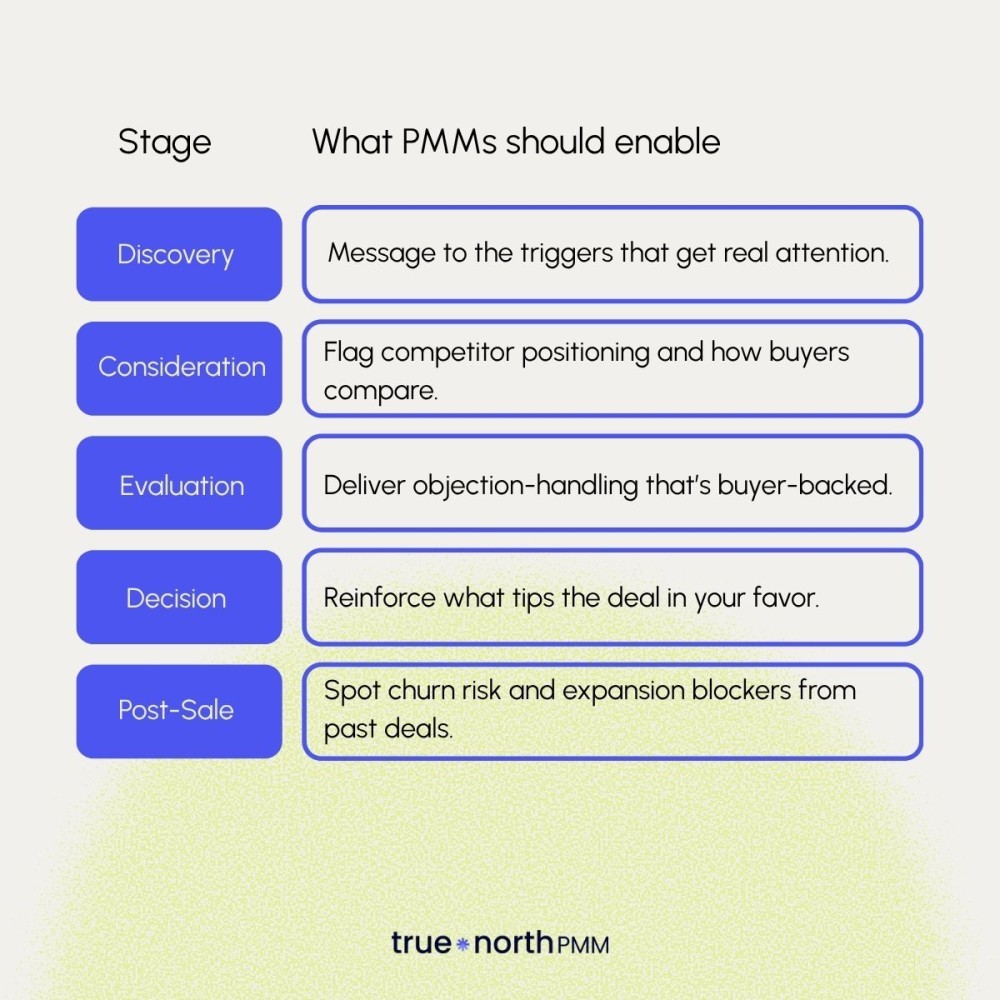
Understanding the buyer journey is crucial for any effective win loss analysis program. Each stage of the journey—from initial awareness to final decision—offers unique insights into buyer motivations, objections, and decision criteria. Sales managers and revenue leaders rely on insights from win loss analysis to better understand the sales cycle and refine their strategies for closing deals at every stage. By mapping feedback and outcomes to specific points in the buyer journey, organizations can pinpoint where messaging, product positioning, or sales tactics may be falling short, and make targeted improvements that drive better results.
Best Practices for Win-Loss Analysis
To get the most out of your win-loss analysis, objectivity and consistency are key. Use a neutral third party to conduct win loss interviews whenever possible—this encourages honest, unfiltered buyer feedback and minimizes internal bias.
Analyze both won and lost deals to get a 360-degree view of your sales performance and competitive positioning. Look for patterns in your win loss data: What key themes emerge? Are there recurring reasons for lost deals, or consistent strengths in deals won? This structured approach to loss analysis uncovers actionable insights that can shape your sales strategies, marketing efforts, and product offerings.
Integrate win-loss insights into your regular business rhythms. Feed findings into quarterly business reviews, sales training sessions, and product roadmap discussions. This ensures that win loss analysis isn’t a one-off exercise, but a continuous improvement engine driving sales effectiveness and business performance.
Common Challenges and Solutions
Implementing a win-loss program isn’t without hurdles. One of the biggest challenges is getting consistent engagement from both your sales team and buyers. Sales reps may be hesitant to revisit lost deals, and buyers may be reluctant to provide candid feedback.
To overcome this, clearly communicate the value of the win-loss program to all stakeholders. Show your sales team how actionable insights from loss analysis can help them close more deals and improve their own performance. For buyers, emphasize that their feedback will be used to enhance the customer experience.
Maintaining data quality is another common obstacle. Relying solely on sales team feedback can introduce bias and limit the depth of your analysis. Instead, diversify your data sources by incorporating buyer interviews, CRM data, and input from internal teams across sales and marketing.
Leverage technology to streamline the process. Specialized win-loss analysis software can automate data collection, improve accuracy, and make it easier to share structured insights across the organization. This not only saves time but also ensures that actionable insights reach the right people—fast.
Finally, ensure that win-loss insights are integrated into your existing workflows. Make them a regular part of sales leadership meetings, sales and marketing strategy sessions, and ongoing training programs. By proactively addressing these challenges, you’ll build a win-loss program that delivers continuous improvement, enhances sales leadership, and gives your organization a lasting competitive advantage.
This Isn’t a Report. It’s a System.
This loop only works when it’s consistent.
Clozd reports:
39% of companies now run continuous, cross-functional win-loss programs
Those programs deliver 85% ROI (vs. 55% for one-off efforts)
72% are owned by GTM, not just CX or product (Clozd, 2025)
A loss analysis program should be ongoing to drive continuous improvement, and some organizations choose to outsource their loss analysis program to third-party providers to minimize bias and gain deeper insights.
This is no longer a “nice-to-have.” It’s the backbone of a responsive GTM strategy.
AI Makes the Loop Work Faster
The feedback loop is powerful, but slow without help.
AI accelerates signal-to-action by:
Summarizing buyer interviews instantly
Letting teams search buyer insights like a knowledge base
Flagging competitor mentions in real time
Tracking shifts in competitor strategy
Processing sales data and structured data from interviews, capturing buyers' own words, and automating win-loss data analysis to organize feedback into actionable themes and trends
It doesn’t replace insight. It removes the friction between hearing it and doing something about it.
The Takeaway
Belief builds pretty decks. Buyer truth builds pipeline.
And product marketing is the team that can turn buyer truth into:
Better product decisions
Sharper messaging
Stronger enablement
More confident GTM strategy
If you're not leading that loop, you're trailing someone who is.
