
Retire "AI-powered." Here's what great positioning actually looks like in 2026.
Every PMM reading this has had the “can we just say AI-powered?” conversation, at least 10x in their career, probably with someone senior, probably while trying very hard not to make a face.
Here’s the gentle truth: “we have AI” is not positioning anymore. It’s a feature everyone has. When every vendor in your category can say the same sentence, that sentence stops helping you win deals. Buyers skim past it the way they skim past “enterprise-grade” or “cloud-native”, those words once differentiated companies too, and now they’re just noise. Without a clear reference point for differentiation, these claims lose their impact because there’s no real difference being communicated.
The harder, more useful question I’ve been asking clients this quarter: what can your product actually do that the two real vendors on the shortlist can’t? Not the 15-logo competitive matrix in the deck. The two names sales keeps hearing in losses. That’s the shortlist your positioning has to beat in the face of real competition and the broader competitive landscape. You need to clearly explain what sets your product apart so customers understand why they should choose you.
Most companies aren’t answering that question. They’re hiding behind the buzzword instead. Go to ten SaaS competitor websites in any crowded category right now and read the hero sections. You’ll find the same words rearranged in slightly different order.
“The all-in-one AI platform for [function].”
“Streamline your [workflow] with agentic [noun].”
“The modern [category] solution powered by AI.
Strip the logos off and you genuinely can’t tell the companies apart. That isn’t positioning. It’s wallpaper.
Market positioning involves establishing a unique identity for your brand or product in the minds of consumers relative to your competitors. To do this effectively, companies must provide a clear frame of reference for their product’s category and differentiators, and define the space in which their product competes so customers know which alternatives they should compare it to.
The good news: A few companies handling the AI-positioning question differently, and in my view, well.
Positioning in marketing is the strategic process of defining a unique, desirable space for a brand, product, or service in the minds of target customers relative to competitors.
Sharpen the positioning statement. Retire "AI-powered."
There are different types of positioning strategies, including price-based, quality-driven, feature-specific, and customer-focused approaches. The range of strategies available allows companies to offer not only products but also services tailored to diverse customer needs. Maintaining consistency and being consistent in messaging and experience across all touchpoints is crucial for reinforcing your brand’s identity and building trust.
Understanding these types helps companies choose the most effective method for their market. In this context, positioning is established relative to competitors and market dynamics, ensuring your brand stands out meaningfully.
The question I’ve been asking clients this quarter, and it’s a deceptively hard one, is: what can your product actually do that the two real vendors on the shortlist can’t? Not the 15-logo competitive matrix in the deck. The two names sales keeps hearing in losses. That’s the shortlist your positioning has to beat. Comparative positioning is key here, it involves directly comparing your product with alternatives to highlight your unique selling propositions. Differentiation positioning, on the other hand, focuses on features or benefits that cannot be easily replicated by competitors, allowing your brand to stand out in the market. The right approach is determined by market conditions and customer needs.
A few companies handling the AI-positioning question differently, and in my view, well.
Too many companies hide behind buzzwords instead of identifying the gap in the market that effective positioning seeks to fill.
Legora — elevating the buyer, not the product.

Legora sits in one of the noisiest B2B categories of 2026: legal AI. Over $4 billion poured into legal AI in 2025, and homepages across the category have converged on almost identical language: “domain-specific AI for legal,”“AI platform for lawyers,”“intelligent legal workflows.” The company (which rebranded from Leya after participating in Y Combinator’s Winter 2024 batch) could have led with the same framing. It chose not to, instead positioning itself as a leader in the legal AI space by focusing on the unique needs of top-tier legal professionals.
The current hero on legora.com reads: “Law just got more attractive. Collaborative AI for exceptional lawyers.” The sub-line: “Spend less time on routine, and more time on the work only lawyers can do.” And the vision statement from CEO Max Junestrand goes further: “Lawyers bring judgment, strategy, and creativity. AI brings speed, scale, and precision. Together, they unlock new possibilities for how legal work gets done.” One notable phrase from their copy, “exceptional lawyers,” reinforces their focus on elevating the profession.
Notice what’s happening in the language: it’s aimed at “exceptional lawyers,”“practising law at its highest level,”“the work only lawyers can do.” That tone is doing deliberate work. The positioning isn’t “AI that replaces lawyers” or “AI that makes lawyers faster”, both of which would put the product on the defensive with a profession that’s famously skeptical of tech. Instead, Legora targets a specific segment of the legal market—partners and senior associates at firms like Dentons, Goodwin, Deloitte, and CMS (all prominently on the logo wall)—with a positioning particularly suited to skeptical legal professionals. Their approach acts as a bridge between tradition and innovation, allowing Legora to be perceived as both progressive and respectful of legal expertise.
The before: one of many “AI for legal” vendors competing on capability claims.
The after: a positioning that elevates the buyer. Lawyers don’t want to be told they’re being automated; they want to be told they’re being freed up to do their best work. Legora wrote copy for exactly that emotional truth, crafting messaging for the intended audience with a bit more nuance than competitors.
Why it works: in a category where nearly every competitor is making the same functional claims, tone and buyer-respect are genuine differentiators. CEO Max Junestrand made the positioning distinction even sharper in March 2026, when asked how Legora competes with generalist AI: “It’s amazing that everybody can have their own pocket lawyer in Claude, but we’re not solving for the same use case.” A platform for the specific workflows of complex legal work, not a chatbot you talk to. Legora’s unique value is defined in relation to these generalist tools, emphasizing depth and specialization over breadth.
Notice what Legora is not leading with: “agentic,” “autonomous,” “AI-powered.” Those claims live on sub-pages for buyers who want the technical depth. The homepage itself is about a lawyer, the work they actually want to do, and a vision of how AI fits around that, not over it.
The takeaway: when your buyer is a skeptic, of tech, of AI, of anything that threatens their expertise, your positioning has to respect them. Elevating the buyer is a positioning move in its own right, creating a sophisticated perception that appeals to those seeking a premium, refined experience. It’s also the one most AI companies get wrong.
Segmentation positioning tailors a brand’s message to specific groups within a broader market, addressing the unique needs and characteristics of each segment.
Brand positioning plays an important role in helping a brand stand out from competitors and ensures that marketing messages resonate with the intended audience.
Granola — naming the user, not the technology.
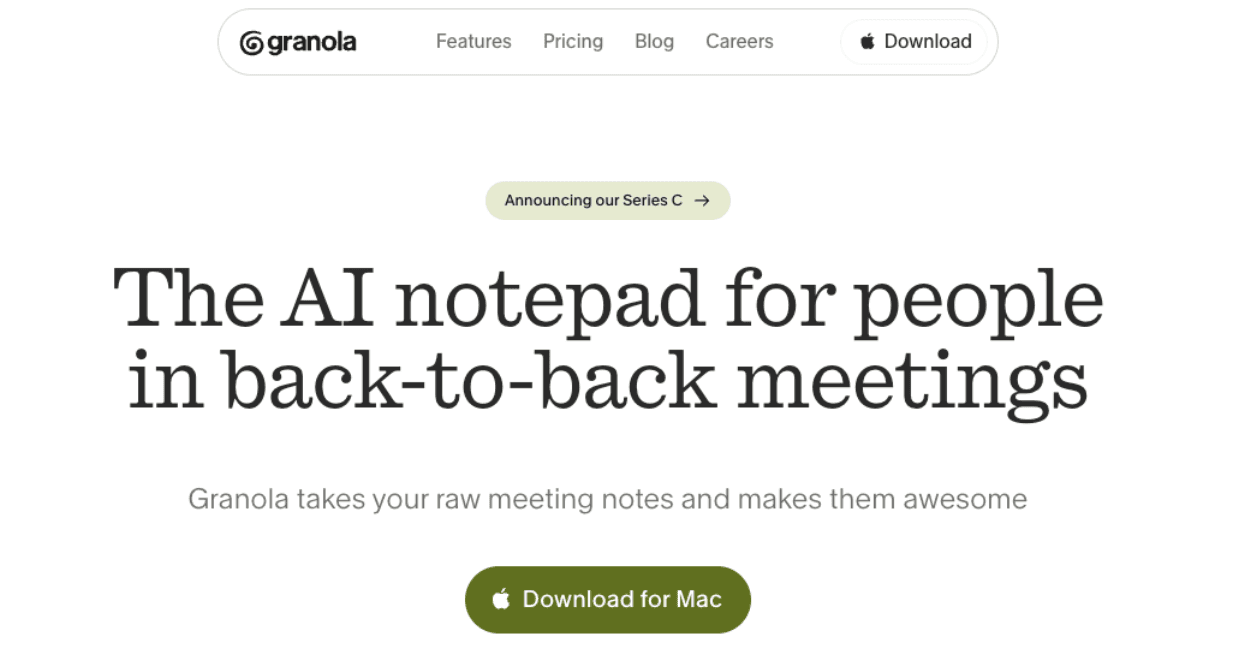
Granola’s homepage hero is worth writing on a sticky note: “The AI notepad for people in back-to-back meetings.” Not “AI-powered meeting intelligence.” Not “agentic assistant for knowledge workers.” A notepad. For a specific person. In a specific situation.
The rest of the page reinforces it relentlessly: “no meeting bots joining your call,”*“transcribes your computer’s audio directly,”* customer logos from exactly the kind of customers who live in back-to-back meetings (VCs, founders, PMs at Intercom, Linear, Vercel, Brex). This positioning directly influences consumer perceptions by making it clear who the product is for and why it matters to them. Granola’s target users are often in the middle of back-to-back meetings, needing a tool that fits seamlessly into their workflow.
Why it works: Granola identified their best-fit user and built the entire message around a lived experience you can either recognize yourself in, or you can’t. If you live in back-to-back meetings, every sentence on that page feels like it was written for you. If you don’t, it wasn’t meant for you, and Granola is at peace with that. The simplicity of their messaging ensures that the value proposition is immediately clear and accessible.
The discipline here is that Granola isn’t trying to serve everyone. They’re serving a specific person, with a specific problem, in a specific moment, ensuring their positioning remains highly relevant to their target audience. Granola’s differentiation sits right at the surface of the user experience—what makes it valuable is visible from the very first interaction.
Effective brand positioning involves identifying the brand’s key differentiators and clearly articulating these in a way that resonates with the target audience.
The takeaway: in a category where every competitor is chasing the broadest possible TAM with the vaguest possible language, the company that names the narrowest possible user most specifically is the one buyers remember. Granola’s positioning is more appealing because it directly addresses the needs and desires of its chosen audience.
Gamma — betting on a category shift, not a feature.
Gamma could have pitched itself as “AI-generated slides” and become one of forty tools claiming the same thing. Instead, the framing is a new medium for presenting ideas: presentations, documents, and websites built on the same engine, designed for a world where the PowerPoint-style deck is starting to feel old. Gamma is creating a new category that redefines how users engage with content, and they create a distinct narrative that sets them apart from traditional presentation tools.
Why it works: feature-led positioning ages badly. The moment a competitor matches the feature, you’re back to square one. Category-shift positioning, when it’s right, keeps working because the wave keeps moving. Gamma is betting the format itself is changing, opening up potential for future growth and improved business outcomes; AI is the engine underneath, not the story on top. Once this category shift is established, new forms of storytelling, branding, and user engagement happen as a result.
AI is the engine underneath Gamma’s product. It’s not the story on top. The story is about where the world is going, and Gamma positioning themselves there first. Successful positioning strategies not only focus on where the product is today but also on how it could progress to where you would ideally like it to be in the near future. Market positioning strategies define how a product is perceived relative to competitors, aiming to establish a unique, valuable space in consumers’ minds. Gamma’s presentations appear on the screen as dynamic, interactive experiences, reflecting this new approach.
The takeaway: feature parity catches up fast. Category positioning, if it’s grounded in a real shift buyers already feel, gives you a strategic advantage competitors can’t shorten just by shipping the same capability.
The pattern underneath.
Three companies. Three different categories. Three different positioning moves:
Granola named the user with surgical specificity, demonstrating a clear focus on prioritizing a particular user segment.
Gamma named the category shift and put itself at the front of it, showing focus on a market transition that matters most.
Legora named the aspiration, what the buyer wants to be, not just what the buyer wants to do, highlighting focus on the core desire driving customer decisions.
Notice what’s not leading any of these pitches: “AI-powered.” “Intelligent.” “Agentic platform.” “The leading [category] for the age of AI.” Each one could have written those sentences. None of them did.
Instead, each leads with one of three things:
A specific user in a specific situation
A specific shift the buyer is already feeling
A specific aspiration the buyer already has
AI is the engine running underneath. The positioning is about what the engine does for the buyer. That inversion — buyer on top, AI underneath — is the positioning move of 2026. Every company still leading with “AI-powered” or “agentic platform” is essentially saying we haven’t decided who we’re for yet. Here, positioning informs the messaging that resonates with the intended audience. The foundational positioning statement clarifies the unique value for the buyer, while positioning defines the company’s direction and strategic priorities.
Just as GPS coordinates help you pinpoint an exact location, positioning helps a company find its precise place in the market. Think of the competitive landscape as a browser window—your brand needs to sit in a spot where it remains visible and relevant, no matter how the market scrolls or shifts. The essence of effective positioning is in defining who you serve, what shift you lead, or what aspiration you enable—so your brand can stand out in the market and sit confidently within its context. Defining your positioning with clarity ensures your offering is differentiated and memorable.
Effective positioning provides internal teams with a clear framework, making sales pitches more effective and marketing spend more efficient. It serves as the North Star for a company, ensuring every business decision aligns with a central identity. A positioning strategy is a set of actions and processes designed to improve the image and visibility of a brand, company, or product.
What to do about it.
If you’re a PMM: pick one objective. Not all three, not a combination, not a hedge. One. Who is this for, most specifically? What shift are they already feeling? What do they aspire to that this product unlocks? Answer one of those questions better than anyone else in your category and your homepage rewrites itself.
Effective positioning measurement starts by mapping metrics across the full customer lifecycle, including awareness, engagement, conversion, revenue, and retention metrics. Just as the Global Positioning System helps you pinpoint your exact location, finding the right market position requires precise tracking and adjustment to ensure you’re on the optimal path.
If you’re a CMO or founder: the most valuable thing you can do for your PMM team this quarter is give them air cover to make the positioning specific, even when the specific version feels less exciting than the buzzword version. Specific wins deals. Buzzwords win nothing.
The trend worth watching through the rest of 2026: as agentic AI goes from novelty to table stakes, the distance between “we have agents” and “we own a specific outcome for a specific buyer” is going to become the most valuable real estate in B2B positioning. The companies that close that distance first get the category. Everyone else gets compared on features. There is a wide range of positioning strategies and outcomes available, and choosing the right one can set your brand apart. Outcomes are now the focus, and organizations have shifted from tracking only brand awareness to measuring business impact. To succeed, you must identify and track the right metrics throughout the positioning process, ensuring you are delivering tangible value. Measuring positioning effectiveness means being responsible for tracking outcomes that matter to the business, not just creative efforts. The visible impact of effective positioning rises to the surface, making your brand stand out in a crowded market.
Today’s product marketers face increasing pressure to demonstrate positioning impact through hard business metrics, moving beyond traditional brand awareness surveys.
To measure the effectiveness of positioning, organizations should establish clear attribution for positioning-driven initiatives, tracking which themes generate the most qualified leads and pipeline velocity.
Determining the right positioning strategy requires a deep understanding of your business’s capabilities and the competitive landscape.
Retire “AI-powered.” The buyer isn’t listening for it anymore.
